 |
| Picture source: http://www.glasbergen.com/wp-content/gallery/hospital-cartoons/hosp1.gif |
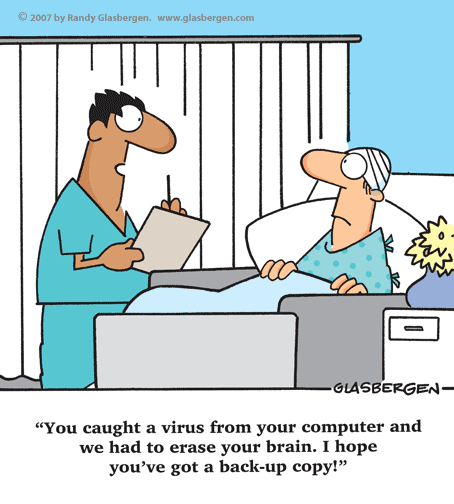
Hopefully it is obvious that the above cartoon is not an actual medical diagnosis. I am using it to illustrate that most people are familiar with the diagnosis a doctor may give to a patient but not everyone is aware that information gathered during a nursing assessment is used by nurses to form nursing diagnoses (for the record the above is not a nursing diagnosis either, it is just a cartoon). Nursing diagnoses use clinical judgement from the nurse and are an important part of the nursing process. A diagnosis of this type may involve actual or potential health problems or life processes as it pertains to the patient, the patient's family or his/her community. In the case of gliomas, the following five nursing diagnoses may be experienced by brain tumor patients:
1) Impaired memory
2) Risk for falls
3) Ineffective self-health management
4) Decreased intracranial adaptive capacity
5) Interrupted family processes
Impaired memory related to the medical diagnosis of a glioma in the left temporal lobe.
The plan, outcome, and nursing interventions that a nurse might use would be completely dependent on the size of the tumor as well as the progression and type of treatment course for the patient.
Sources:
Lewis, S. (2011). Medical-surgical nursing: Assessment and management of clinical problems. (8th ed.). St. Louis, Mo.: Elsevier/Mosby.
What is Nursing Diagnosis And Why Should I Care? (2015, January 1). Retrieved March 2, 2015, from http://www.nanda.org/What-is-Nursing-Diagnosis-And-Why-Should-I-Care_b_2.html

No comments:
Post a Comment